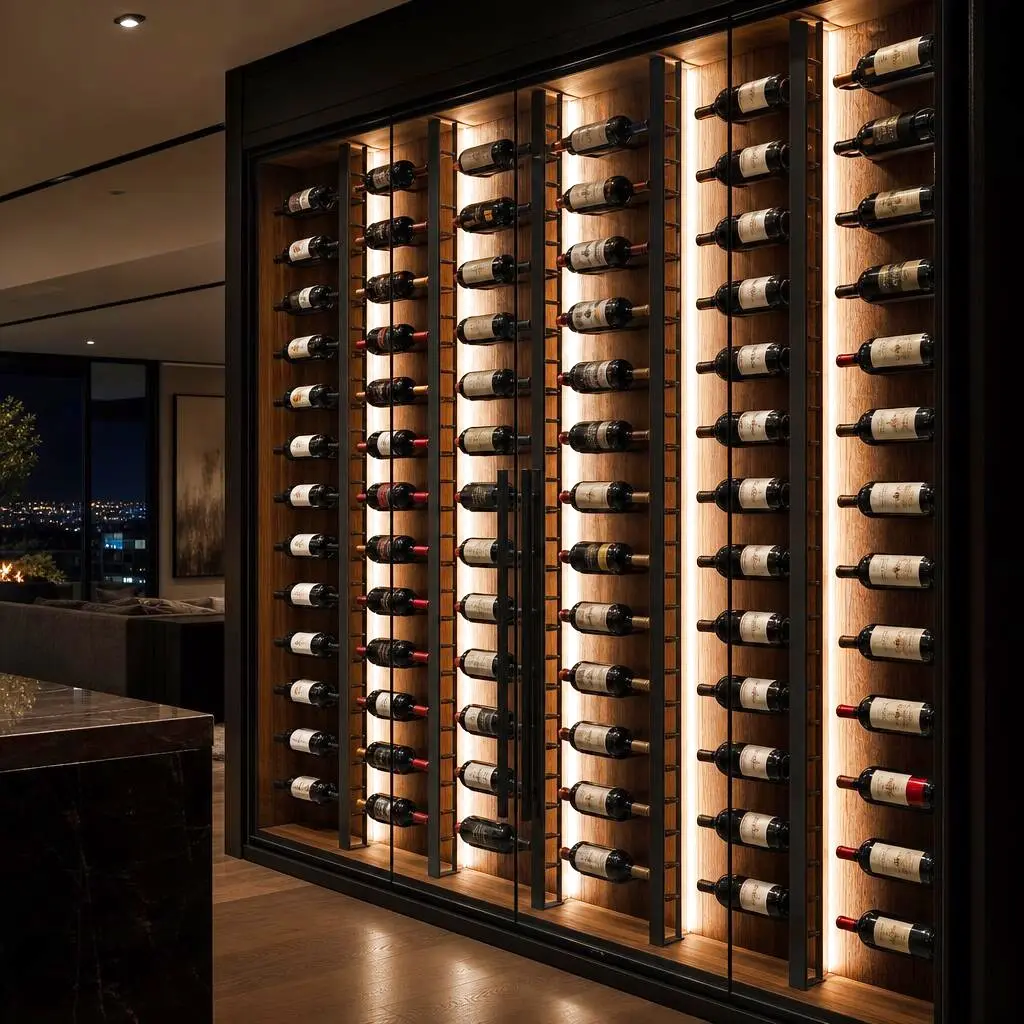
The custom home features most worth the investment in Utah are the ones you use daily and that align with your market: wine walls, home saunas and cold plunges, media walls, hidden pantries and sculleries, smart garages, and heated driveways. These earn their cost twice — through everyday enjoyment and through resale appeal in the luxury markets where buyers expect them. The features to approach carefully are hyper-personalized touches that only you would value. Here's how to prioritize.
Features That Deliver Daily and at Resale
High-return custom features for Utah homes
| Feature | Typical Cost | Why It's Worth It |
|---|---|---|
| Wine wall | $8k – $40k+ | Statement focal point; strong appeal in luxury markets |
| Sauna + cold plunge | $12k – $45k+ | Wellness trend; year-round use in Utah's climate |
| Media wall | $6k – $30k+ | Anchors the living space; hides clutter and wiring |
| Hidden pantry / scullery | $10k – $35k | Keeps the main kitchen pristine; high buyer demand |
| Smart garage | $8k – $30k | Everyday utility; signals a modern, cared-for home |
| Heated driveway | $4k – $30k+ | Real differentiator in snow country |
What Makes a Feature "Worth It"
Before picking finishes, it helps to define the return you're actually chasing. Custom features pay off along two axes: use value (how often the feature improves your daily life) and market value (how much a future buyer will pay for it). The best investments score high on both. A wine wall you walk past every night and that buyers in a luxury Salt Lake City neighborhood expect is a stronger bet than a niche installation that only suits your habits. When the two axes diverge — a feature you'll love but the market won't reward — that's fine, as long as you go in with clear eyes.
The two-question test
- Will I use it every week? Weekly-use features (a scullery, a sauna, a smart garage) almost always justify themselves through sheer convenience.
- Would a likely buyer pay for it? If comparable homes in your area already showcase the feature, it protects and often lifts resale.
Wellness: The Feature Category That Keeps Growing
Home wellness has moved from luxury to lifestyle. A sauna and cold plunge setup gets used year-round in Utah — a sauna warms up the long winters, and a cold plunge is a natural companion after a day on the slopes near Park City. Pair it with a steam shower and you have a genuine home spa that buyers increasingly seek out. Our home sauna buyer's guide covers the options in depth.
The mechanical side is what separates a wellness room that lasts from one that fails. Saunas and steam showers introduce heat and moisture that must be managed with proper vapor barriers, dedicated ventilation, and sealed, mold-resistant finishes — details that matter even more in Utah's dry climate, where the contrast between a steamy spa room and the arid air outside stresses transitions and seals. A cold plunge needs a chiller, filtration, and floor drainage planned into the room from the start. Retrofitting these systems after the fact is expensive, which is why wellness features are best scoped during a broader remodel.
Entertaining: Wine Walls and Media Walls
A wine wall turns storage into a sculptural centerpiece — climate-controlled glass display that anchors a dining room or great room. A media wall does the same for the living space, integrating the TV, fireplace, lighting, and hidden storage into one clean architectural feature. Both photograph beautifully and read as intentional design rather than add-ons, which is exactly why they resonate with buyers in luxury enclaves around Draper.
Entertaining Spaces That Earn Their Footprint
Beyond the walls themselves, dedicated entertaining rooms consistently rank among the features homeowners use most and buyers respond to. A finished lower level built around a home theater, a bar, or a golf simulator room turns unused square footage into the most-used space in the house. In a basement conversion, these features share the same framing, electrical, and finishing work — which is why grouping them into one project is far more cost-effective than adding them piecemeal. The key is designing for real use: comfortable seating, good lighting control, and sound isolation so the space works without disrupting the rest of the home.
Everyday Function: Pantries, Garages, and Mudrooms
- Hidden pantry / scullery: A back kitchen keeps the show kitchen spotless — one of the most requested features in new luxury builds.
- Smart garage: A smart garage with epoxy floors, storage systems, and EV charging is high-utility and buyer-friendly.
- Dog wash mudroom: A dog wash and mudroom is a beloved everyday feature for Utah's active, outdoors-and-pets lifestyle.
Climate-Specific Features Utah Rewards
Some features are worth more in Utah than almost anywhere else. A heated driveway is a genuine luxury and safety upgrade in snow country — we cover it in how heated driveways work. Glass wall conversions capture the Wasatch views that define so many Utah homes, and louvered pergolas extend outdoor living across both the hot summers and cool evenings.
What earns its keep also shifts by region. In the mountain markets around Park City and Heber, features tuned for heavy snow loads and long winters — heated driveways, wellness rooms, generous mudrooms — read as essentials rather than extras. Down in St. George, the calculus flips toward the desert climate: shaded outdoor living under a louvered pergola, glass walls that frame red-rock views, and cooling-conscious design carry more weight than snow-melt. Along the Salt Lake valley in areas like Draper and South Jordan, buyers reward a balance of both. Matching your feature list to the local climate and buyer expectations is one of the simplest ways to protect resale.
Permitting and code, briefly
Many high-return features touch systems that require permits and inspections — electrical for EV charging and smart garages, plumbing and drainage for wellness rooms, and structural or mechanical work for heated driveways. Utah jurisdictions build on the International Residential Code (IRC), with local amendments, so exact requirements vary by city. The practical takeaway: budget for permit timelines and design the feature to code from the outset rather than treating approvals as an afterthought. A design-build team that pulls permits routinely keeps this from becoming a bottleneck.
Common Mistakes to Avoid
- Over-improving for the neighborhood: Spending far beyond the local ceiling rarely returns dollar-for-dollar; scale finishes to your market.
- Ignoring the mechanical backbone: Skimping on ventilation, drainage, or electrical capacity turns a showpiece into a maintenance headache.
- Bolting on features one at a time: Piecemeal projects mean repeated demolition and duplicated trade mobilizations; plan phases together.
- Prioritizing novelty over daily use: A dramatic feature you use twice a year rarely beats a scullery or mudroom you rely on every day.
Features to Approach Carefully
Not every custom feature returns its cost. Hyper-specific rooms built around a single hobby, extreme themed spaces, or finishes far above the neighborhood's norm can be hard to recoup at resale. That doesn't mean don't build them — if you'll love it for years, personal enjoyment is a valid reason — just go in knowing the resale math. A golf simulator room or a hidden door, for instance, is a delight and adds real wow factor in the right market, but value the joy first and the resale second.
How to Prioritize Within a Budget
- Start with features you'll use weekly — daily utility beats occasional novelty.
- Favor features that read as architecture (wine walls, media walls) over bolt-on gadgets.
- Match your investment to your neighborhood's ceiling so resale stays intact.
- Bundle features into the same construction phase to save on shared trades and disruption.
Sequencing Features for Value and Sanity
The order in which you build matters as much as what you build. Structural and mechanical work — framing, electrical service upgrades, plumbing rough-ins, drainage — should always precede finish-level features, because tearing back into finished walls to run a circuit or a water line is the fastest way to double a budget. If a heated driveway, a wellness room, and a smart garage are all on your list, coordinating them under one plan lets shared trades (concrete, electrical, HVAC) work once instead of returning repeatedly. It also compresses the disruption: living through one well-managed project is far easier than a string of overlapping ones. This is where a design-build approach pays off, since design, permitting, and construction stay under one accountable roof.