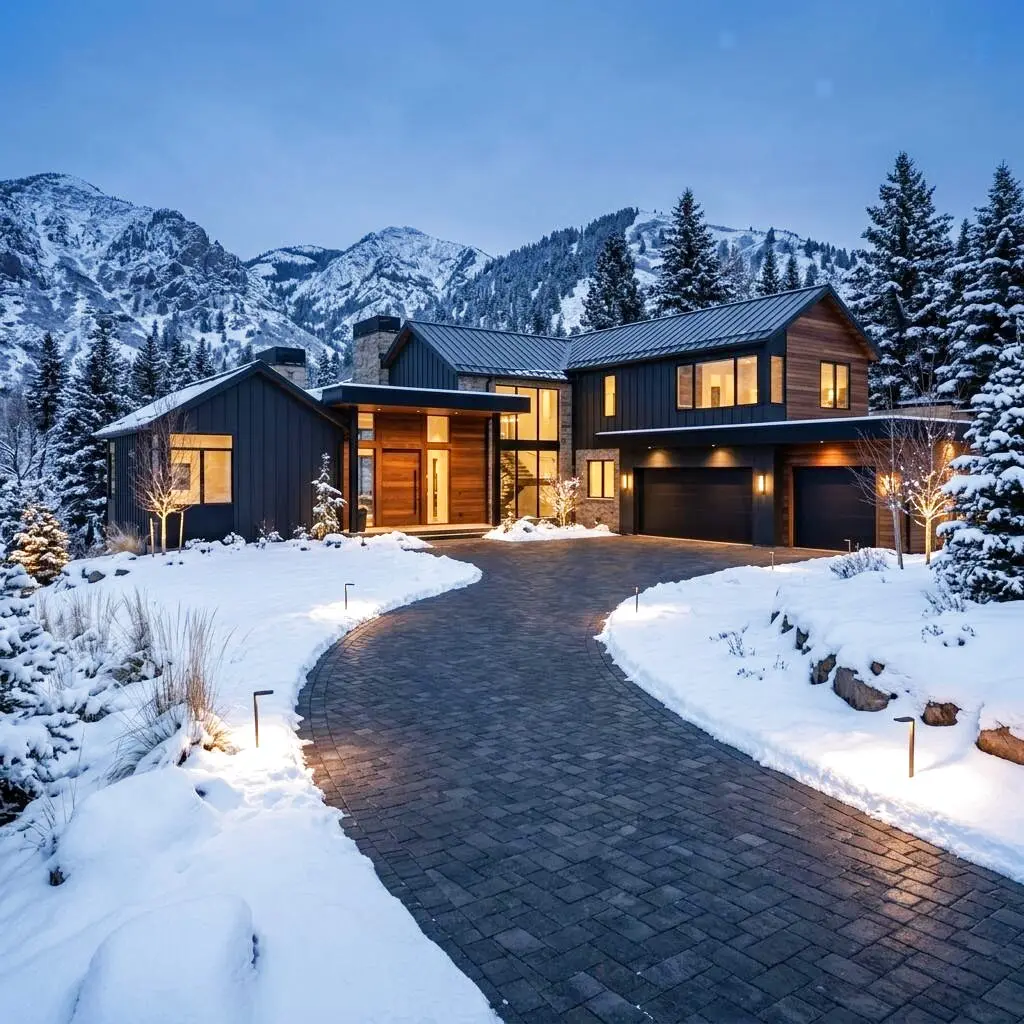
A heated driveway works by running heat — either electric cables or fluid-filled tubing — just beneath the driveway surface, triggered by a sensor that detects falling temperature and moisture so the system melts snow as it lands. In Utah, expect installation to run roughly $12 to $28 per square foot depending on the system, with electric best for smaller areas and hydronic best for large driveways run frequently. Below, how each system works, what drives the cost, and how to choose for a Utah winter.
How Snowmelt Systems Actually Work
Both system types embed a heating element beneath the driveable surface — concrete, pavers, or asphalt. An automatic snow/ice sensor monitors temperature and moisture; when both cross the threshold, it energizes the system so snow melts on contact rather than accumulating. Because the system runs only when needed and can pre-warm the slab, you wake up to clear, dry pavement without touching a shovel.
The Anatomy of a Snowmelt Install
A snowmelt system is more than the heating element. On both electric and hydronic setups you have the in-slab element, an aerial or in-ground snow/ice sensor, and a controller that ties them together. Electric systems add a subpanel or dedicated circuits sized to the load; hydronic systems add a boiler, a circulating pump, a manifold that distributes fluid to each PEX loop, and often a mixing valve to protect the boiler. Getting the loop spacing, slab depth, and insulation beneath the element right is what separates a system that clears the drive quickly from one that struggles in a heavy storm.
Design Details That Matter
- Loop or cable spacing: tighter spacing melts faster but costs more — it should match your storm intensity.
- Under-slab insulation: insulation below the element keeps heat pushing up instead of down into the ground.
- Zoning: large or steep drives can be split into zones so the busiest areas clear first.
- Sensor placement: a well-located sensor prevents the system from running when it shouldn't, controlling operating cost.
Electric vs. Hydronic: The Core Choice
Electric vs. hydronic snowmelt in Utah
| Factor | Electric | Hydronic |
|---|---|---|
| How it heats | Resistance cables in the slab | Heated glycol/water through PEX tubing |
| Best for | Smaller areas, tire tracks | Large driveways, frequent use |
| Install cost | Lower upfront | Higher upfront (boiler + manifold) |
| Operating cost | Higher per storm | Lower per storm |
| Equipment | Cables, sensor, controller | Boiler, pump, manifold, tubing, sensor |
| Maintenance | Minimal | Boiler serviced like any heater |
| Ideal scenario | Short drives, condos, targeted zones | Long/steep mountain driveways |
Electric Systems: Simple and Targeted
Electric systems lay resistance cables (or mats) in the slab and heat up quickly. They're the practical choice for smaller driveways, walkways, and steps, or for heating just the two tire tracks rather than an entire slab. Upfront cost is lower and there's no boiler to maintain, but electricity is the pricier fuel, so operating cost per storm is higher. For most single-car drives and targeted zones, that trade-off makes sense.
Hydronic Systems: The Workhorse for Big Drives
Hydronic systems circulate a heated glycol-water mix through PEX tubing fed by a dedicated boiler. They cost more to install because of the boiler and manifold, but they heat large areas efficiently and cost less to operate per storm — which is why they dominate the long, steep driveways common in Park City and hillside lots in Draper. For a driveway you'll run through a full mountain winter, hydronic usually wins on lifetime cost.
What It Costs in Utah
- Electric install: typically ~$12–$20 per sq ft, best for smaller areas
- Hydronic install: typically ~$18–$28+ per sq ft including the boiler and manifold
- Operating cost: electric runs higher per storm; hydronic runs lower — the gap widens the more you use it
- Retrofit vs. new pour: installing during a new driveway pour is far cheaper than tearing out existing concrete
The Best Time to Install: New Pour vs. Retrofit
The single biggest cost lever is timing. Installing the heating element during a new driveway pour or a planned replacement is dramatically cheaper because the element simply goes down before the concrete does — no demolition, no disposal, no re-pour. Retrofitting into an existing driveway means removing and repouring the concrete, which can double the effective cost of a comparable new install. If you are already planning a driveway replacement, a hardscape refresh, or new construction, that is the moment to add snowmelt. Pairing it with other exterior work like a covered patio or under-deck living space can also streamline the project.
Utah Climate and Code Considerations
Utah's building work follows IRC-based codes, and any snowmelt install involves electrical and, for hydronic, plumbing and gas work that typically requires permits and inspection. Beyond code, the local climate should shape the design. Along the Wasatch Front, lake-effect storms can dump heavy, wet snow that demands responsive melting capacity. At elevation, colder ambient temperatures and larger storm totals push most homeowners toward hydronic for its efficiency at scale. Freeze-thaw cycling is also hard on concrete, so a properly designed system that keeps the slab from repeatedly icing and thawing can extend the life of the driveway itself.
Utah-Specific Considerations
Utah's heavy mountain snow and steep driveways make snowmelt more than a convenience — on an icy incline it's a genuine safety feature. Elevation and storm frequency favor hydronic for the biggest drives, while lower-snow valley homes in Lehi or South Jordan may do well with a targeted electric system. Snow-storage and drainage also matter: melted water has to go somewhere, so proper slope and drainage are part of a correct install. This is our heated driveways specialty.
Park City vs. the Valley vs. St. George
Region should drive the decision. In Park City, Heber, and other high-elevation areas, long steep driveways and big snow totals make hydronic the workhorse — it heats large areas efficiently and costs less per storm to run. Across the Salt Lake valley, in Sandy or Draper, homeowners often choose between a full-slab hydronic system and a targeted electric system that heats just the tire tracks or the steepest section. In St. George, where measurable snow is rare, a full driveway system is usually unnecessary — a small electric zone at a shaded, north-facing entry can handle the occasional freeze.
Mistakes to Avoid
- Retrofitting when you could have poured: waiting until after the concrete is down is the most expensive path.
- Skipping under-slab insulation: without it, heat escapes downward and operating costs climb.
- Ignoring where melted snow drains: refreeze at the driveway edge is a common, avoidable hazard.
- Oversizing electric for a large drive: electric is best for targeted zones; a big all-electric slab can be costly to run.
Understanding Operating Cost
Install cost is a one-time number; operating cost recurs every storm. Electric systems are simple but draw significant power while running, so a large all-electric slab can be expensive over a heavy Utah winter — which is exactly why electric shines for smaller, targeted zones. Hydronic systems cost more to build but heat large areas at a lower cost per hour, and a modern boiler run on natural gas is typically cheaper to operate than resistance heating. The real drivers of your seasonal cost are total storm count, how long the system runs each event, and how well the slab is insulated below the element. A sensor that only fires when snow is actually falling — rather than a timer left running — keeps that number in check.
Maintenance and Longevity
Electric systems are nearly maintenance-free: there is no boiler, so once the cables are set and the controller is dialed in, there is little to service. Hydronic systems include a boiler, pump, and manifold that should be checked periodically like any heating appliance, and the glycol-water mix is monitored so it keeps its freeze protection. Both systems benefit from a quick pre-season check of the sensor and controller before the first storm. Done right, an embedded snowmelt system lasts the life of the driveway, and keeping the slab clear of repeated freeze-thaw cycling can actually help the concrete hold up better over time.
Is a Heated Driveway Worth It?
If you have a steep or long driveway, deal with frequent heavy snow, or simply value never shoveling again, the answer is usually yes — and in snow country it adds real resale appeal. The best time to install is during new construction or a driveway replacement, when the heating element goes in before the pour. Retrofitting into existing concrete is possible but costs more because of demolition.