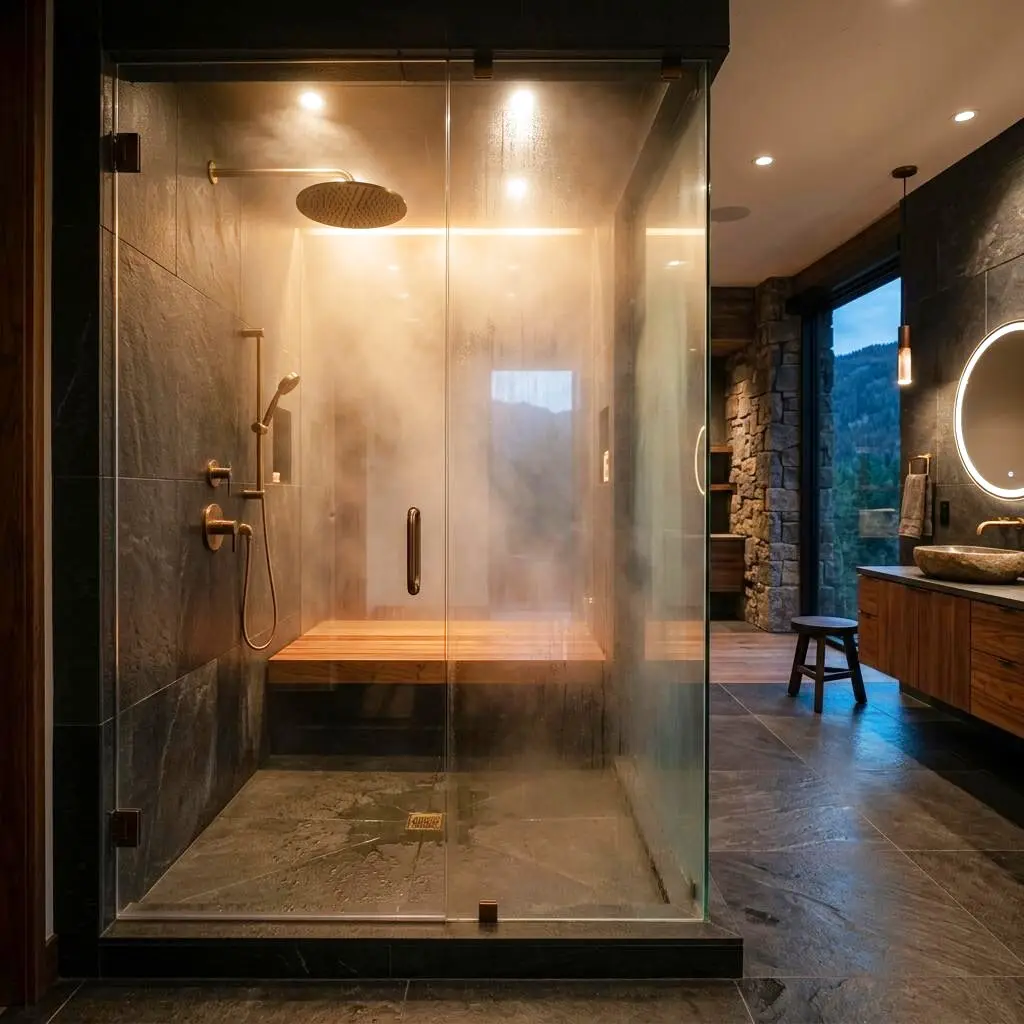
The defining luxury bathroom trend for 2026 is the spa-grade wet room: a seamless, grout-free wet zone where the shower, freestanding tub, and often a steam function share one waterproof, sculptural space. Around it, the direction is warm and quiet — microcement and honed stone instead of glossy tile, bronze and brushed brass instead of chrome, integrated lighting instead of fixtures, and wellness features like steam and heated everything moving from rare to expected. Here is what is actually landing in high-end Utah homes this year.
1. Seamless, Grout-Free Surfaces
The single strongest trend is the move away from tile grid and grout lines toward monolithic surfaces. Microcement lets you wrap walls, floors, shower pans, and even vanities in one continuous, waterproof material with subtle hand-troweled movement. The result reads calm and modern, and it is far easier to clean than a tiled wet area. We explore the material choice in depth in our comparison of microcement vs. tadelakt.
2. The Spa Wet Room
Rather than a glass box in the corner, 2026 bathrooms treat the shower and tub as one open, curbless wet zone. Add a bench, a linear drain, a rain head plus a handheld, and — increasingly — a steam shower function, and the bathroom becomes a genuine at-home spa. This works beautifully in larger primary suites common in Draper and Lehi new builds.
Getting the wet room details right
A wet room lives or dies on its unseen details. The floor needs a subtle continuous slope toward a linear drain, and the waterproofing membrane has to be continuous from the shower zone out into the surrounding floor so there is no threshold to trip the water. A curbless entry also demands careful coordination between framing and drain depth early in the build — retrofitting slope into an existing slab is far more involved than planning it from the start. Because the tub and shower share one open space, we typically zone the heat and lighting so the wet area can run warmer and brighter than the vanity zone. When these fundamentals are handled properly, the room feels effortless; when they are skipped, it puddles, stains, and dates quickly.
3. Warm Metals and Quiet Palettes
Chrome is out; unlacquered brass, aged bronze, and matte black fixtures are the finish story for 2026. They pair naturally with the warm, earthy neutrals — bone, greige, clay, deep espresso — replacing the cool grays that dominated the last decade. The overall effect is closer to a boutique hotel than a builder bathroom.
4. Wellness Built In
- Steam: A generator-fed steam shower is the most-requested wellness upgrade of the year.
- Heat everywhere: Heated floors, towel bars, and even heated benches in the wet room.
- Chromotherapy & sound: Integrated color lighting and waterproof audio in the shower.
- Sauna + cold plunge adjacency: High-end suites increasingly place a sauna and cold plunge next to the bath.
5. Statement Stone, Used Sparingly
Where microcement keeps things quiet, a single dramatic slab — a bookmatched stone feature wall behind the tub or a monolithic stone vanity — provides the focal point. The 2026 approach is restraint: one hero material, not five competing ones.
6. Layered, Integrated Lighting
Lighting has quietly become the biggest differentiator between a builder bathroom and a designed one. The 2026 direction layers three or four sources — warm recessed cans for wash light, backlit mirrors for a shadow-free vanity, low-level toe-kick and niche lighting for nighttime, and often a dimmable feature light over the tub. Warm color temperatures around 2700K read as luxurious rather than clinical, and everything runs on dimmers so the same room can be bright for a morning routine and low for an evening soak. On new builds and gut remodels we plan the electrical layout alongside the tile and stone so light grazes surfaces intentionally instead of flattening them.
Costs: What a High-End Bathroom Actually Runs
Budgets vary widely with size and scope, but the biggest cost drivers are consistent. A seamless-surface installer and proper waterproofing are labor-intensive and typically the single largest line after cabinetry and stone. A steam shower adds a generator, a sealed enclosure, and a sloped ceiling, and heated floors add both material and an electrical circuit. A full luxury primary bathroom remodel in Utah often runs from the mid five figures into six figures once you include structural changes, high-end fixtures, custom cabinetry, and integrated wellness features. Spending more on the things behind the wall — and being selective about visible splurges — is how the best projects stay on budget without feeling value-engineered.
Where luxury bathroom budget typically goes
| Category | Relative Share | Notes |
|---|---|---|
| Waterproofing & surfaces | High | Seamless installs are labor-heavy; do not cut here |
| Cabinetry & stone | High | Custom vanities and hero slabs drive cost |
| Wellness features | Medium–High | Steam, heated floors, sauna adjacency |
| Fixtures & hardware | Medium | Solid-brass valves and daily-touch pieces |
| Lighting & electrical | Medium | Layered, dimmable, integrated |
| Trend accents | Low | Easy to swap later |
What's in and what's fading for 2026
| Element | In for 2026 | Fading |
|---|---|---|
| Surfaces | Seamless microcement, honed stone | Glossy subway tile, busy mosaics |
| Metals | Bronze, brass, matte black | Polished chrome |
| Palette | Warm neutrals, earth tones | Cool gray on gray |
| Shower | Curbless wet room + steam | Small glass corner enclosure |
| Lighting | Integrated, layered, warm | Single overhead fixture |
| Vanity | Floating, warm wood, stone top | Bulky white shaker |
Designing for Utah Specifically
Utah's dry climate and hard water shape smart bathroom choices. Steam and humidity features need proper vapor barriers and ventilation to protect the rest of the home, and honed or sealed surfaces resist hard-water etching better than polished finishes. In mountain markets like Park City, heated floors and towel bars are less a luxury than a comfort standard through a long winter. Getting the mechanical detailing right is what separates a bathroom that photographs well from one that performs for a decade.
Regional notes across the state
The right emphasis shifts by market. In the Salt Lake valley — Draper, South Jordan, and Sandy — hard water is the dominant concern, so we lean on honed finishes, whole-home or point-of-use softening, and fixtures that hide scale. In cold, high-elevation markets like Park City and Heber, winter comfort features and robust ventilation matter most, and vapor management is non-negotiable for steam. Down in warmer, sun-drenched St. George, the palette often runs lighter and brighter and glare control at windows becomes part of the design. In every market, Utah bathrooms are permitted and inspected under IRC-based building, plumbing, and mechanical codes, so ventilation, waterproofing, and electrical for wellness features all have to meet code — one more reason to build with a team that handles the mechanical detailing.
Mistakes to Avoid
- Skimping on ventilation: A gorgeous wet room with an undersized fan will trap moisture and shorten the life of every finish around it.
- Chasing too many trends at once: Five hero materials fight each other; pick one focal point and let the rest stay quiet.
- Choosing polished stone in a hard-water zone: It etches and spots quickly — honed or sealed surfaces hold up far better.
- Leaving waterproofing to the last responsible bidder: The membrane, slope, and steam barrier must be planned early, not improvised on site.
- Ignoring lighting until the end: Layered, dimmable light has to be roughed in with the electrical, not added as an afterthought.
How the Project Comes Together
A luxury bathroom that performs starts long before demo. The sequence that consistently produces the best result runs design and material selection first, then structural and mechanical planning, then the trades, and finishes last. Waterproofing, steam vapor barriers, and radiant heat are roughed in and inspected before any surface goes on, the seamless installer works on properly prepped substrate, and lighting is dimmed-in with the electrical rather than patched later. Because so much of the value is invisible — membranes, slope, ventilation, blocking for wall-hung fixtures — the order of operations is what protects both the budget and the ten-year durability of the space. Rushing finishes ahead of the fundamentals is the single most common way a beautiful bathroom quietly fails.
Where to Invest and Where to Save
- Invest: Waterproofing, ventilation, steam generators, and a seamless surface installer — the things you cannot redo cheaply.
- Invest: Fixtures you touch daily — a good handheld, a quality valve, solid-brass hardware.
- Save: Trend accents like a single feature light or accessories that are easy to swap later.